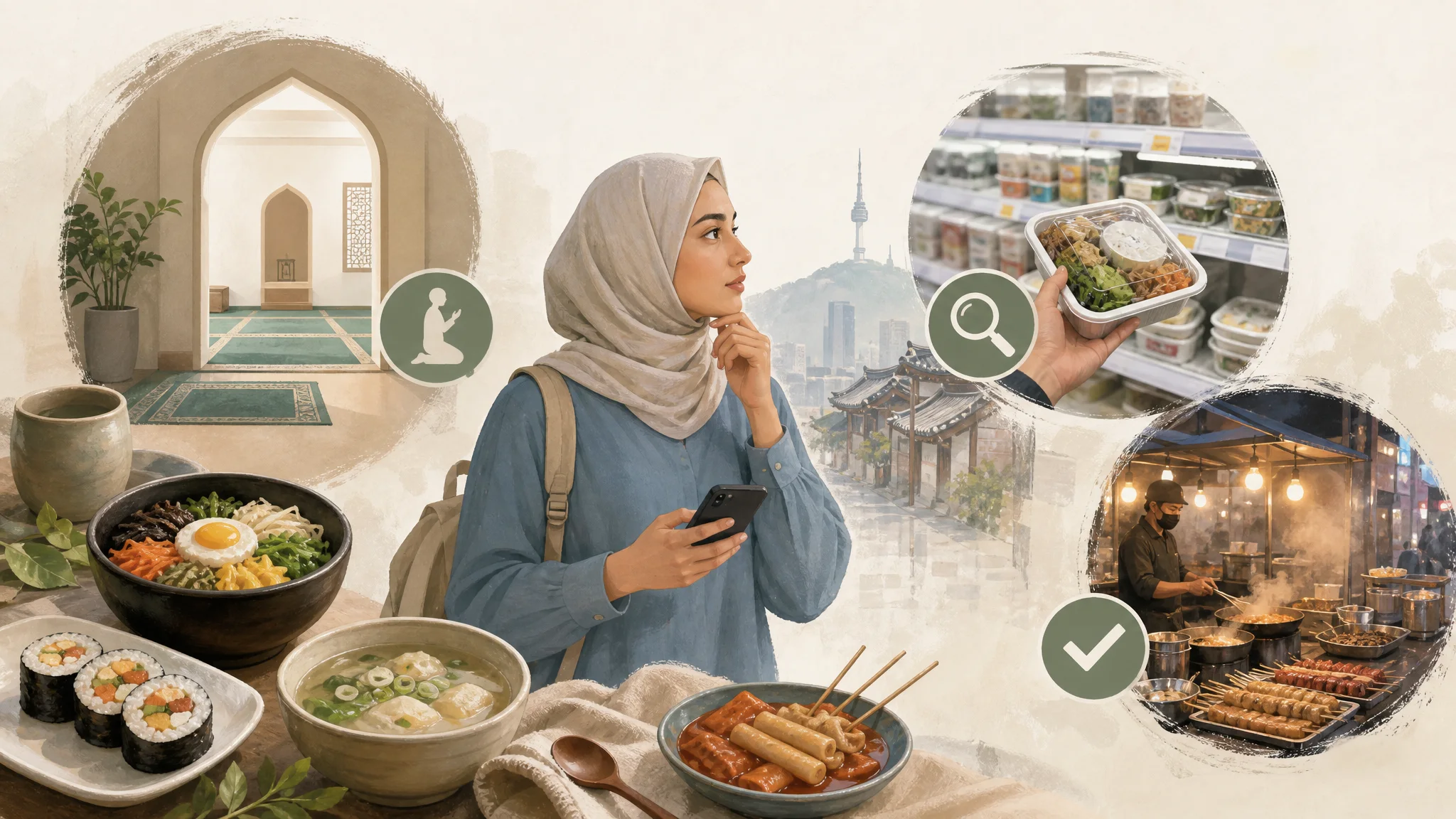
Quick summary — practical rules you can use now
Korea has growing prayer-room access and halal options centered around airports, mosques, and Seoul's Itaewon halal food district, but many regular restaurants and street foods commonly use non‑halal ingredients such as anchovy or fish cakes (myeolchi/odeng), meat broths, or gelatin. Plan prayer and meal routes before you travel, check ingredient lists on packaged foods (ingredient names), and use the checklist and Korean phrases below when eating out.
Prayer rooms and locations (when and where to use)
Airport (Incheon) — prayer rooms are located after immigration
- Main point: All designated prayer rooms at Incheon Airport are located in the duty‑free area beyond immigration. That means you can use the airport prayer room after check‑in, security, and immigration, inside the duty‑free zone. (Airport maps and information desks show 'Prayer Room' signage.)
- Practical tip: If you are in transit, bookmark the duty‑free prayer room location for your terminal in advance (many are near gates on upper floors). They are not available before security/immigration.
City prayer rooms and mosques — Itaewon (Seoul Central Mosque) is the main hub
- Main point: In Seoul, Itaewon (Usadan‑ro area), especially the Seoul Central Mosque (Seoul Central Mosque), is the core of halal restaurants, prayer, and community. Jumu'ah (Friday) prayer is usually announced around 13:00, so plan Friday schedules with that in mind.
- Practical tip: Arrive by 12:30–12:45 if you plan to attend Jumu'ah (crowds are common). Staying in Itaewon makes meal choices much easier.
Practical checklist — what to check immediately at convenience stores and packaged foods
- Short checklist when buying packaged products:
1) Check the ingredient list (ingredient names and contents) — Korean labeling law requires ingredient disclosure, so you can look for pork (돼지고기, 돼지), gelatin (젤라틴), fish paste/fish meat (어육), anchovy or anchovy extracts (멸치·멸치추출물), etc.
2) Also check allergy/containment notes (milk, egg, shellfish).
3) If there is no foreign‑language label, look for Korean words like '돼지', '돼지고기', '젤라틴', '라드', or '돈' to identify pork-derived ingredients.
4) If ingredients are grouped (e.g., 'soup base', 'seasoning mix'), ask staff directly or verify with a trusted app (see below).
- Quick Korean phrases (for ordering / asking):
* Does this food/product contain pork? — "이 음식에 돼지고기 들어가요?" (i eum‑sik‑e dwae‑ji‑go‑gi deu‑reo‑ga‑yo?)
* Does it have gelatin or pork-derived ingredients? — "젤라틴이나 돼지 유래 성분 있나요?" (jel‑la‑tin‑i‑na dwae‑ji yu‑rae seong‑bun it‑na‑yo?)
* Is this broth (soup) made with anchovy or a meat bone broth? — "이 국물 멸치육수예요, 아니면 고기육수예요?" (i guk‑mul myeol‑chi‑yuk‑su‑ye‑yo, a‑ni‑myeon go‑gi‑yuk‑su‑ye‑yo?)
Street food (tteokbokki, odeng, etc.) — ingredients to watch
- What to watch for: Korean street food that may look vegetarian or seafood‑based often uses broths or processed items (fish cake/odeng) that include fish (anchovy) extracts, shellfish, or meat bone broths. Tteokbokki sauces are commonly cooked with anchovy stock, and odeng/fish‑cake products may list fish paste or anchovy powder among ingredients.
- Practical rule: When buying street tteokbokki or odeng, always ask "Does the fish cake/odeng contain pork or pork‑derived ingredients?" or "Is this broth anchovy stock?" If unsure, ask them to omit fish cake or choose items with clearly visible ingredients like eggs or kimbap.
Comparison table — decision rules by situation
| Situation | Recommended choice | Reason / what to check |
|---|---|---|
| Halal‑certified (or KMF‑certified) restaurants available | Book certified restaurant | Certification is issued after kitchen and supply‑chain checks (safest) |
| Near certified businesses or Muslim‑owned restaurants (self‑declared) | Confirm meat type on the menu, check for prayer space | Most exclude pork and manage alcohol, but confirm specifics |
| Typical tourist areas / street food | Seafood or vegetarian dishes (bibimbap, pajeon, sundubu) or clearly visible items in areas like Itaewon | Always confirm whether broths, fish cakes, or sauces are used |
| Convenience store / ready meals | Check ingredient list for 'pork', 'gelatin', 'anchovy', 'fish meat' | Korean law requires ingredient labeling (easy to find) |
Apps, tools, and a practical route
- Useful apps: Muslim Pro (prayer times, qibla, restaurant search), KoreHalal / HalalTrip (restaurant & mosque search), Naver Map (search in Korean).
- Example 1‑day Seoul route: Arrive at Incheon → pray in the airport duty‑free prayer room (if appropriate for departure) → take the airport railroad to Seoul → check in at an Itaewon hotel → dinner at an Itaewon certified restaurant or a restaurant near the mosque (expect halal BBQ around ₩20,000–35,000 per person) → during sightseeing choose pork‑free or seafood options.
Who this guide is for (trade‑offs and conditions)
- This advice is practical both for travelers who require formal halal certification and for those who only avoid pork and alcohol.
- Trade‑off: Sticking only to certified restaurants may increase travel time (staying in or near Itaewon can be more convenient). Mixing local restaurants increases options but requires more ingredient checking.
Additional precautions (verification & prevention)
- When you see a certification sign in a restaurant, check the certification body name (KMF, etc.). Some places may display self‑declaration rather than third‑party certification.
- If a packaged product has unclear labeling or you cannot read Korean, ask store staff or scan product information via QR code or an app.
- For Friday Jumu'ah times (commonly 13:00), check local mosque announcements; arrive 30–45 minutes earlier if you are near the mosque.
One‑line closing
Korea is not a fully halal city, but with airport prayer rooms, the Itaewon halal hub, and an increasing number of certified restaurants, a little advance planning (prayer locations, certification checks, and a few Korean phrases) lets you enjoy Korean food safely and comfortably.