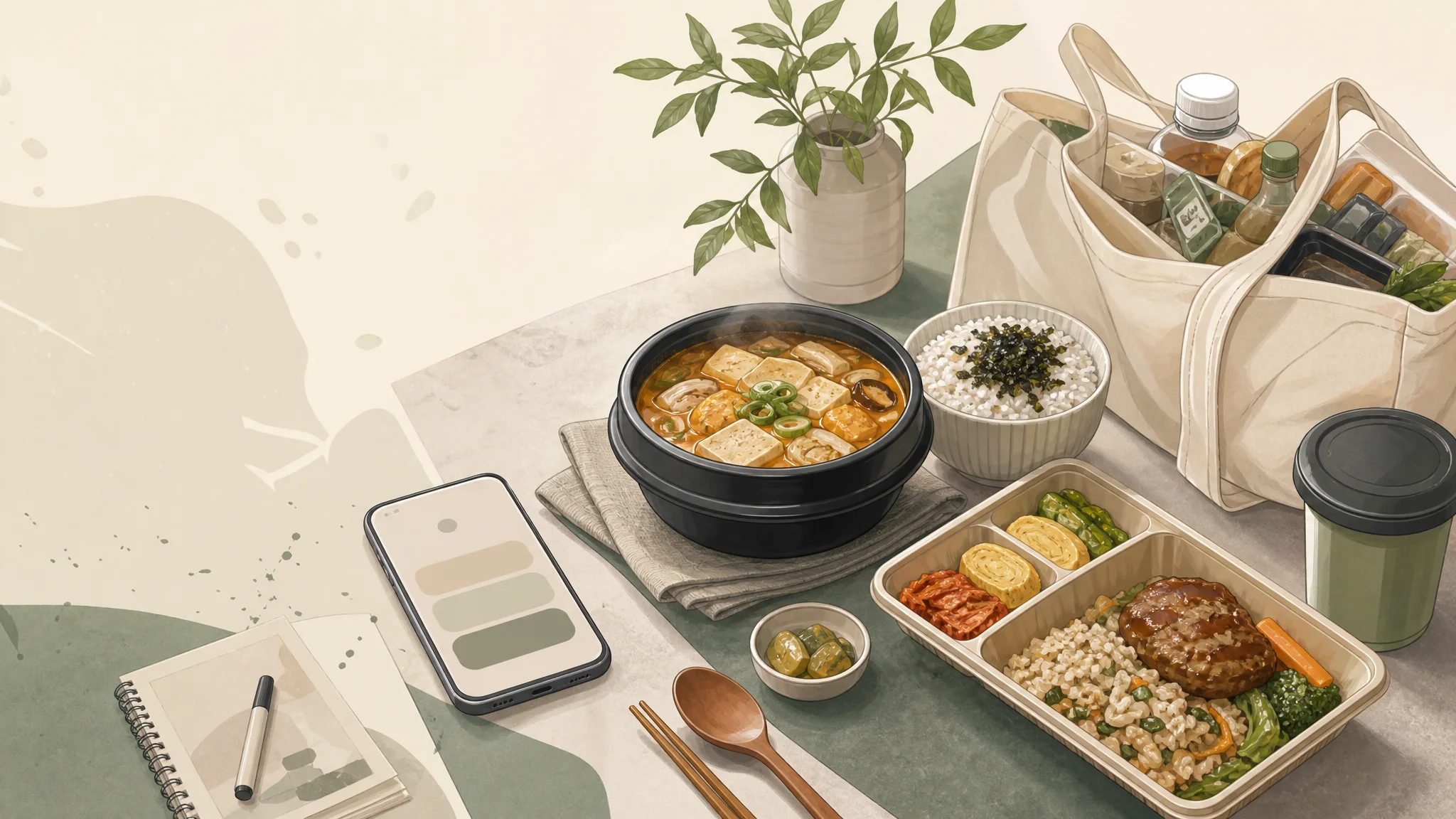
Key summary — Direct answer: South Korea's recent food culture has reorganized around convenience: HMR/meal kits + convenience-store dosirak (3–7k KRW range) + delivery (mind minimum-order and delivery fees). Choose one of HMR, meal kits, convenience-store dosirak, or delivery based on your situation (budget, time, health priorities).
What changed: consumption indicators and market signals - Single-person households increased: recent surveys show the share of single-person households has risen and a high proportion report difficulty maintaining a balanced diet. (Growing solo-living population increases demand for convenient meals.) - HMR, meal kits, and delivery growth: demand for HMR and meal kits expanded after COVID-19, and online food and delivery channels now account for a large share of food distribution. - Convenience-store premiumization and collaborations: convenience stores offer higher-quality dosirak made with celebrity chefs or brands, with prices ranging from low 3,000 KRW to premium around 6,000 KRW.
(Who is this advice for?) This guide is aimed at international students, workers, single-person households, and visitors in Korea who need a fast, practical meal solution.
Practical: decision rules for "what to eat" by situation (3-step decision) 1) Check time/buffer: if you can eat in 15–30 minutes choose a meal kit or cookable HMR; if you need food within 10 minutes, go for a convenience-store dosirak. 2) Set your budget: 3,000–4,500 KRW (value/convenience store), 4,500–6,500 KRW (premium convenience-store or some meal kits), 10,000 KRW+ (delivery meal including delivery fee). 3) If health/allergies matter, check the ingredient/nutrition label — watch sodium, additives, and allergen ingredients.
Recommended decision rule (simple):
- Budget ≤ 5,000 KRW + speed prioritized → convenience-store dosirak (3–5k KRW)
- Want balanced nutrition and a cooking experience → meal kit (15–40 min prep)
- Want immediate delivery convenience (but consider delivery fee/minimum order) → order via delivery app
Situation-based recommended menus and price examples (field-use guide) | Situation | Recommended type | Price (example) | Ordering/purchase tips | Cautions | |---|---:|---:|---|---| | School/library lunch (fast, low budget) | convenience-store dosirak, rice balls | 3,000–4,500 KRW | Check convenience-store apps for coupons, use microwave | Check sodium and side-dish freshness | | Busy office worker (nutrition + value) | premium convenience-store dosirak, protein rice balls | 4,500–6,500 KRW | Use app discounts and card promotions | Check calorie and protein labels | | Solo special occasion (hearty) | premium HMR, meal kit, or premium convenience-store | 6,000 KRW+ (meal kits can be pricier) | Reserve on e-commerce like Market Kurly or other marketplaces | Check shelf life and storage instructions | | Late-night snack (prefer delivery) | delivery (chicken, Korean, Chinese food) | food price + delivery fee (3,000–5,000 KRW range) | Check minimum order and delivery fee; consider grouping orders | Recalculate total cost including delivery/service fees |
Korean phrases to use when ordering (simple expressions) - In-store (convenience store): "이거 하나 주세요." ("This one, please.") / "전자레인지에 데워 주세요." ("Please heat it in the microwave.") - Delivery app requests (note): "뜨겁게 부탁드려요." ("Please keep it hot.") / "문 앞에 두고 가주세요." ("Please leave at the door.") - Restaurant takeout: "포장해 주세요." ("Can I get this to go?") / "매운맛 조절(안 매운 것으로) 가능할까요?" ("Can you make it less spicy?")
Ingredients, allergies, and nutrition cautions (must-check) - Processed convenience meals can be high in sodium; if you want low-salt options, check the nutrition label. - Allergens such as nuts, eggs, milk, and soy are listed on labels. People with allergies must read packaging carefully. - Ready-to-cook products require checking storage and reheating instructions (expiration date, refrigerated/frozen storage).
Trade-offs and pros/cons - Convenience-store dosirak: pros = fast and cheap; cons = potential imbalance in nutrition and high sodium. - HMR/meal kits: pros = variety and potential for balanced meals; cons = price and prep time (meal kits require cooking). - Delivery: pros = convenience and wide choice; cons = delivery fees, minimum orders, and possible delays.
(When would recommendations change?) Recommendations may shift if delivery fees drop or if there are no convenience-store promotions, or because of personal health needs (low-sodium/low-calorie) making HMR or home-cooked meals preferable to convenience-store options.
Checklist — five things to check before ordering/buying 1. Budget (food price + delivery fee) 2. Time until consumption (eat soon or store) 3. Allergies/ingredients (check labels) 4. Shelf life and storage instructions (refrigerated/frozen markings) 5. App/store discounts (coupons, promotions) applicability
Sources and reliability: This advice is compiled from Korean statistics, market reports (government/industry/academic) and recent market observations. On-the-ground promotions, new product launches, and regional price differences may change recommended price ranges, so always confirm actual prices in the app or store before buying.