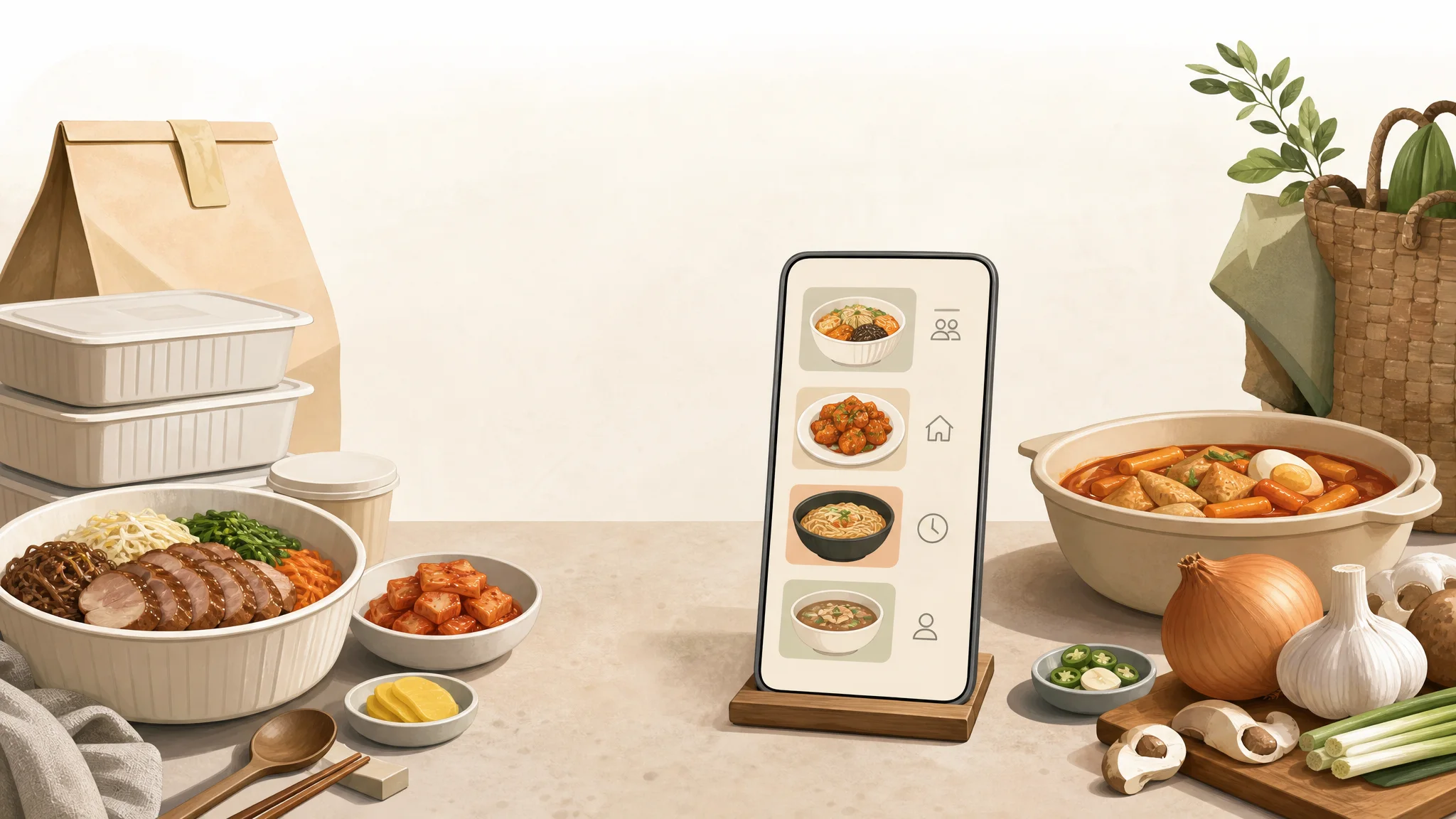
Quick summary — short answer: If you’re alone, order chicken (single box) or street-food-style sets (tteokbokki and gimbap); for two or a small group, chicken with beer or a jokbal set; for larger groups, bossam, hotpot (jeongol), or grilled pork belly sets offer the best balance of delivery efficiency and satisfaction. Price examples come from industry guides and travel resources and will vary by neighborhood, time, and promotions.
Recommendations by situation and example prices (verified examples) The table below lists common delivery choices and what to expect. Prices are example figures drawn from public guides and travel materials.
| Menu | Delivery advantages | Verified price example | Delivery / reheating notes |
|---|---|---|---|
| Korean fried chicken (1 box) | Filling, good for sharing, top late-night pick | ₩20,000 (example guide) | Maintaining crispness is key — ventilated boxes are preferred. Reheat in an oven or air fryer rather than a microwave. |
| Tteokbokki + fried sides set | Good value, holds up well in packaging, popular late-night option | ₩15,000 (example set) | Sauce can change texture if absorbed; best eaten soon after delivery. |
| Jokbal (pig's trotters) (set for 2) | Keeps quality in delivery, good for sharing | ₩30,000–₩45,000 (full set example) | Store refrigerated and reheat by steaming or warming; watch for high fat and salt. |
| Jajangmyeon / Jjamppong (Chinese-Korean noodles) | Traditional delivery staple, durable packaging | Varies by neighborhood and restaurant | Broth and noodle quality change over time — eat soon after arrival. |
(Table source: public delivery and travel guides; prices are examples and can change by location, time, and promotions.)
Pre-order checklist — payment, delivery notes, allergies - Payment setup: Korean delivery apps commonly require local payment methods and phone verification. If you’re a foreign visitor, check for hotel/shuttle-friendly services or apps with English support. - Typical delivery fee: Varies by area, time, and minimum order but often a small fee (for example around ₩3,000–₩5,000) depending on app promotions. - Delivery note examples: - Put it at the door — 문 앞에 놓아 주세요. (Mun ap-e noh-a juseyo.) Used for contactless drop-off. - Please call on arrival — 오시면 호출해 주세요 / 전화해 주세요. (Yeonrak juseyo.) - Allergy phrases (clearly state specifics to the restaurant/delivery): - I have an allergy / [ingredient] allergy — 알레르기가 있어요 / [성분] 알레르기 있어요. For severe allergies, add phrases like "must be completely omitted" to request prevention of cross-contact. - If unsure what to say: capture a photo of the menu item and paste it into the app’s request box to reduce miscommunication.
Packaging, storage, and reheating (safety and texture tips) - Packaging differences: Many Korean fried-chicken shops use ventilated boxes or mesh liners to slow the loss of crispness. Check packaging for ventilation to set expectations for texture on arrival. - Recommended reheating for crispness: Use an oven (about 400°F / 200°C with a wire rack) or an air fryer for roughly 6–15 minutes to restore crunch. Microwaves tend to make fried foods soggy and should be a last resort or used only as a helper method. - Storage: Refrigerate cooked food and consume within 3–4 days under normal home-storage guidelines. Avoid leaving perishable food at room temperature for more than two hours. If freezing, follow proper thawing and reheating instructions.
Short ready-to-use ordering phrases (copy and paste) - I’ll take one of this. — 이거 하나 주세요. (Igeo hana juseyo.) — when selecting a single item on the menu. - Please leave it at the door. — 문 앞에 놓아 주세요. (Mun ap-e noh-a juseyo.) — for contactless delivery. - I have an allergy to [ingredient]. — [성분] 알레르기가 있어요. — to warn about allergies.
Who this advice helps and what trade-offs you’re making - Who it helps: Travelers and short-term visitors ordering delivery in Korea for the first time, and local consumers who want a fast decision method. The guide includes practical tips on apps, payments, and language barriers. - Trade-offs: Choosing "quick and easy" options means some dishes (soupy hotpots and brothy items) will degrade in quality over delivery time. Choosing options that preserve taste may increase delivery cost and waiting time. - What can change prices and options: Local promotions, delivery company policies, and regional price levels can alter menu prices, delivery fees, and operating hours. Check the app for current prices, ratings, and estimated delivery times right before ordering.
6-second pre-order checklist 1. Confirm payment method is registered and whether the app supports English. 2. Check minimum order, delivery fee, and estimated arrival time. 3. Note allergies or dietary/religious restrictions in the request box. 4. Check packaging ventilation — especially for fried chicken. 5. Decide if you need to eat immediately (soup/noodle dishes are best fresh). 6. Plan reheating method (can you use an oven/air fryer?).
If you want, tell me your city (for example Seoul, Busan, Jeju) and budget and I can find popular local delivery items, average prices, and apps with English support for that area.