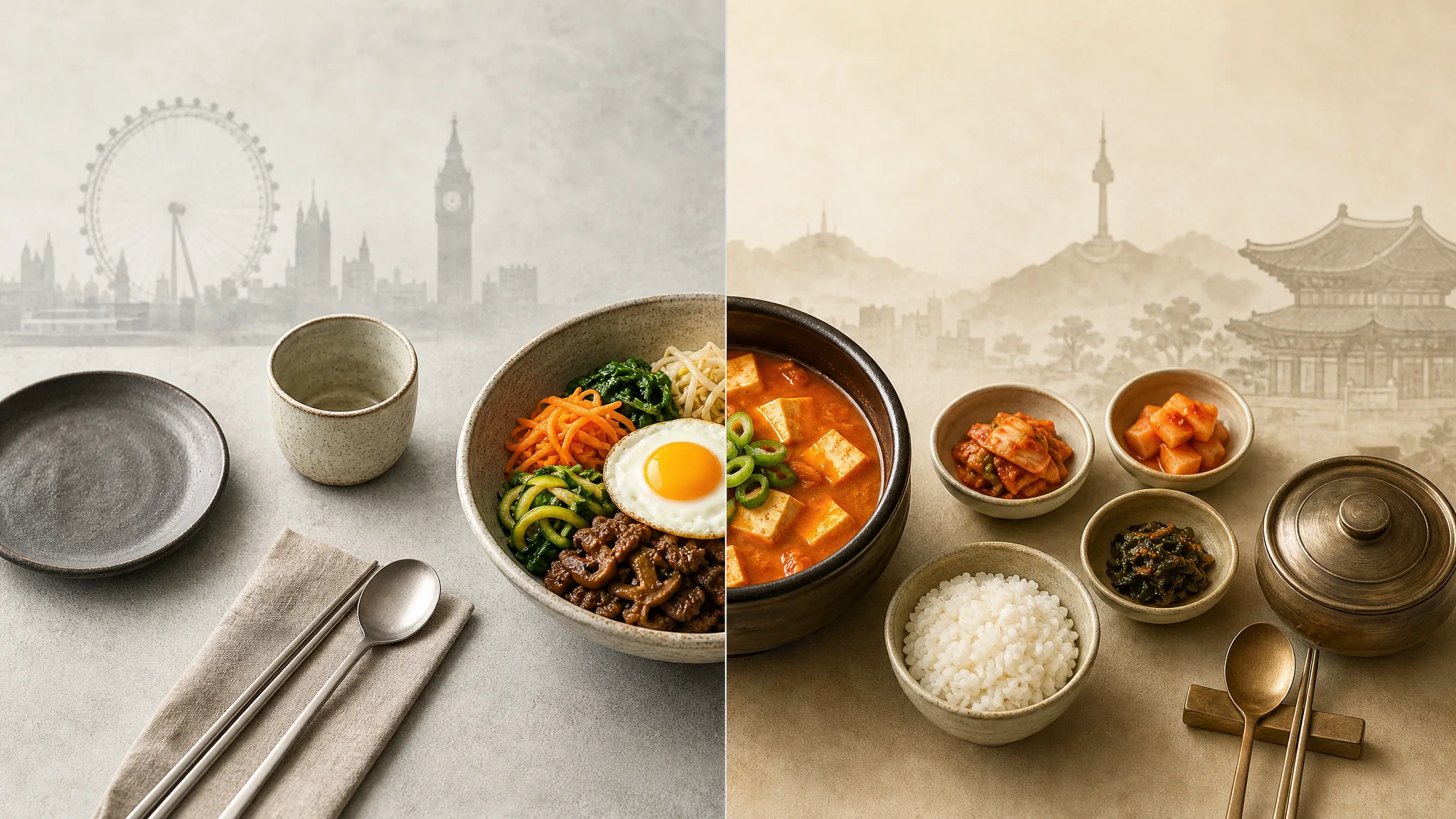
Key takeaway — one-line answer: You can get excellent Korean food in London, but expect differences in price, ingredient composition, and service style (table setup, banchan, etc.) compared with the average dining experience in Korea (especially Seoul); choose based on your goal (authenticity vs value vs convenience).
Price and value — reality from verified examples Comparing real examples from Seoul (official statistics) and London (restaurant menus/guides) highlights decision points.
| Menu | Seoul (Price.go.kr · official average · 2026 data) | London (examples · restaurant menus / guides) |
|---|---|---|
| Bibimbap (single serving, typical restaurant) | about ₩11,700–₩12,000 (2026 Price.go.kr · H1–Sep aggregates) | Jinjuu Classic Bibimbap £12 (menu PDF); some casual shops offer £6–£9 (Seoul Bakery, etc.) |
| Korean fried chicken (single portions; street vs restaurant vary) | Varies by shop/cut (generally cheaper in Korea for comparable portions) | Jinjuu’s signature Korean fried chicken £11; festival/food-market portions and sets vary locally |
| Lunch set (central/casual) | In Korea, baeksang/regular set meals typically in the ₩8,000–₩13,000 range | Central London lunch specials and sets commonly £10–£20 (much cheaper options also exist depending on the shop) |
Practical summary: the same dish can have a large price gap in London between central higher-end restaurants and casual/takeaway shops. Seoul’s Price.go.kr averages show a relatively lower mid-range urban price.
What to order — recommendations by situation (goal & budget) - If you want authentic flavor (Korean local taste) - Prioritize dishes where ingredients and technique matter: grilled meats (table BBQ), dolsot bibimbap, seolleongtang and stews. New Malden area in London tends to concentrate restaurants and supply chains with stronger Korean authenticity. - If you want value or a quick meal - Central London casual chains (e.g., bibimbap chains, Seoul Bakery) offer inexpensive single-bowl options around £6–£9 that are good for a quick, cheap Korean meal. - If you want a social dining experience (party, BBQ, sharing) - Table BBQ (samgyeopsal, galbi) is a fun experiential option in London, but per-person costs can be higher than in Seoul.
Decision checklist to choose:
1) Purpose: pick either ‘authenticity’ or ‘value’. If you want both, target New Malden or a Korean food festival (e.g., Jung Fest).
2) Budget: under £10 → casual/takeaway (bibimbap, kimbap); £10–£25 → mid-range restaurants; £25+ → high-end/fusion/tasting menus.
3) Party size: solo/lunch → bibimbap or noodles; 2+ people → BBQ or platters.
Ordering phrases and allergy/diet notes (practical phrases) - Simple English ordering examples - "One classic bibimbap, please." (비빔밥 하나 주세요) - "Could you make this with no egg? I'm allergic to eggs." (계란 빼주세요. 알레르기가 있어요.) - "Is this vegetarian/vegan? Does it contain anchovy stock or fish sauce?" (이거 채식/비건인가요? 멸치 육수나 액젓(젓갈)이 들어가나요?) - Korean ordering (useful at Korean-run restaurants or in New Malden) - "비빔밥 하나 주세요. 고추장은 따로 주세요." — a simple, common phrasing. - "저는 채식이라서 고기 빼 주세요(고기 제외 부탁드립니다)." — when asking to remove meat, always confirm whether side dishes or broths contain fish/anchovy-based ingredients.
Allergy/diet notes
- Side dishes (banchan) may contain anchovies, jeotgal (fermented seafood), or broths made with anchovy; vegetarians/vegans and people with shellfish/fish allergies should always check.
- Fermented sauces (gochujang, doenjang, soy sauce) can include shellfish-derived ingredients, and cross-contamination during cooking is possible.
Where to go in London — proximity vs authenticity trade-offs - Central (Soho, Bloomsbury, Hackney): high accessibility and a mix of trendy fusion/modern Korean restaurants and value-oriented casual shops (e.g., Seoul Bakery, bibimbap chains, Miga). - New Malden: a Korean community hub where restaurants and ingredients tend to be more authentic and prices are often reasonable. - Festivals & pop-ups (e.g., Jung Fest): good opportunities to try street food and emerging brands in one place; schedules vary.
Who this advice fits, trade-offs, and what may change - Intended readers: visitors or residents in London who want to quickly decide what to order and how Korean food compares to Korea. - Trade-offs: choosing authenticity usually costs more and may be less convenient; central low-cost options are cheaper but may localize ingredients and banchan composition. - Factors that can change prices and options: exchange rates, ingredient supply, openings/closures of restaurants, and local festivals/pop-ups (e.g., Jung Fest). Also, Price.go.kr dining price data may change after 2026.
Quick decision checklist (5-second rule)
- Budget under £10 → look for central casual shops (Seoul Bakery, bibimbap chains) and order bibimbap/kimbap.
- Budget £10–£25 → explore restaurant menus (dolsot bibimbap, stews, fried chicken) or lunch sets.
- Want authentic, carefully prepared meal → prioritize New Malden restaurants, BBQ specialists, or Korean-run establishments.
Sources and notes: This guide is based on Price.go.kr dining-price statistics from the Korea Consumer Agency, London restaurant menus (public PDF), and local media coverage and guides (Time Out, The Standard) including festival reports. Local menus and prices change frequently—check the restaurant’s current menu or booking page before visiting.