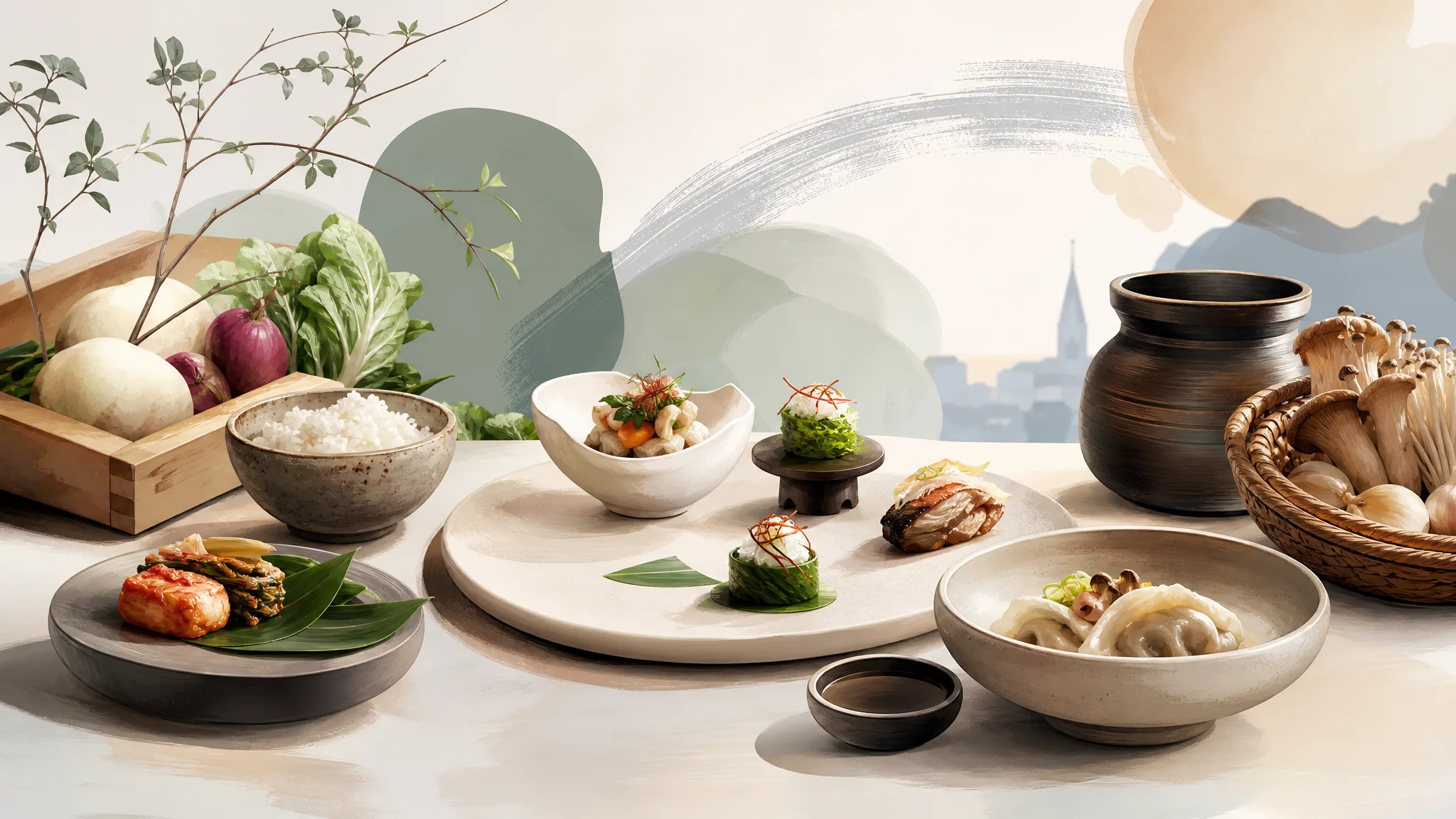
Key summary — bottom line: At Paris Korea House (2024) the invitation-only opening banquet was run with a fusion Korean course developed by Cuisine.K, while a bibigo pop-up and "bibigo market" offered casual street and packaged items to the public. The invited banquet was for official guests only; the pop-up/market operated in sales or tasting mode depending on on-site conditions, so verify availability and purchasing options locally before deciding.
Who this guide is for, and what trade-offs you’re choosing - Intended readers: visitors to Paris (or nearby) during the Olympics, travelers looking for K-food pop-ups at events, and food lovers prioritizing fusion Korean dishes or on-site tasting. - Trade-offs to consider: - If you want a quick meal, prioritize bibigo’s street/takeaway items (corn dogs, ready meals). - If you want an official, representative Korean dining experience, the invitation-only opening banquet (invitation required) offers a plated course designed for guests and is a group event. - If you have dietary restrictions or allergies, you must check ingredients in advance (ask on-site staff or check labels). - Recommended decision rules: 1) If you have limited time and mobility: go to the bibigo pop-up for instant street food. 2) If you want a photo-worthy, explanatory experience of Korean fusion cuisine: look for exhibits or panels related to the Cuisine.K-designed banquet menu. 3) If you have allergies or religious dietary restrictions (pork, shellfish, gluten, dairy, etc.): ask staff directly "Does this contain [ingredient]?" before ordering.
Key verified facts at Paris Korea House (2024) that affect purchases or experiences - Dates and venue: Korea House officially opened on July 25, 2024 at Maison de la Chimie and operated during the Games. (The official opening ceremony was an invitation-only event.) - Who organized it: Korea House was run under the Korean Sports & Olympic Committee with collaboration from CJ (title sponsor), the Ministry of Agriculture, Food and Rural Affairs, and the Korea Foundation for Korean Cuisine to operate food promotion and tasting programs. - What was publicly shown (examples): The Cuisine.K banquet menu included fusion and traditional items such as bokdae (blackmouth croaker) tacos, chogye-tang (cold chicken soup), soondae skewers, and a French-style japchae; bibigo showcased casual items at its pop-up including corn dogs and prepackaged bibigo convenience meals.
> Note: The opening banquet menu was an invitation-only plated service; the pop-up’s sale/tasting availability and prices varied by on-site conditions. The organizers did not publish standard retail pricing for these event offerings.
On-site quick checklist — seven steps to decide what to order or pick 1. Check hours: "Is Korea House open for general visitors today?" Confirm access rules (free/booking/waitlist). 2. Choose your purpose: quick street meal vs. traditional/fusion tasting (exhibit/demonstration). 3. Allergy check: confirm presence of shellfish (shrimp paste), pork (soondae, boiled pork), gluten (batter, bread, noodles), dairy (aioli/sauces), etc. 4. Prepare ordering language (French/English): have short phrases and Korean dish names ready. - French example: "Bonjour, un corn dog s'il vous plaît." / "Est-ce qu'il y a des crevettes?" (Is there shrimp?) - Korean examples (if staff speak Korean): "이 메뉴에 새우가 들어가나요?" / "채식 메뉴 있나요?" 5. Ask for photos and explanations: fusion dishes vary by site—request ingredients and preparation notes. 6. Check payment and receipts: pop-ups may accept different payment methods (card/cash), check in advance. 7. Packaging and storage: ready-to-eat items can change texture with travel—confirm packaging if you’re carrying food long distances.
Ready-to-use French and Korean phrases for ordering and checking (use on the spot) - Asking recommendations (French): "Qu'est-ce que vous recommandez?" - Allergy questions (French): "Est-ce qu'il y a des crustacés/du porc/du gluten?" (shellfish/pork/gluten) - Vegetarian options (French): "Avez-vous une option végétarienne/vegan?" - The same questions in Korean (useful if menu has Korean script): "이 음식에 새우/돼지고기/밀가루가 들어가나요?"
Ingredients and allergy points to check on site - Seafood (shrimp paste, mixed seafood dishes): hidden fermented condiments such as shrimp paste may be used—those with shellfish allergy must verify. - Pork (soondae, boiled pork, tteokgalbi): ask if pork is used for religious or dietary reasons. - Gluten (batter, bread, noodles): corn dogs, fried items, and some japchae/noodle dishes may contain wheat. - Dairy (aioli/sauces): some fusion sauces may include dairy.
Comparison table: choices visitors will face (summary) | Option | Best for | Pros | Cons | Price / purchase info (verified) | |---|---:|---|---|---| | Invitation-only opening banquet (Cuisine.K) | Those who want a curated fusion Korean course but are invited guests | A chef-designed, plated fusion Korean course | Not open to the general public (invitation-only) | Individual pricing or public sale information was not published (invitation event) | | bibigo pop-up / bibigo market | Visitors wanting casual, quick K-food experiences | Instant street food and branded product trials | Items and sales/tasting availability varied by on-site operations | No official published prices; check on-site signage | | Exhibits / demonstrations / samplings (government or institution-run) | Visitors wanting educational experiences about ingredients and techniques | Formal demonstrations and cultural context | May involve queues or participant limits | Participation format follows event notices |
(Note) The "Price / purchase info" column above is listed as 'not published' because event organizers (Korean Sports & Olympic Committee, the Ministry of Agriculture, Food and Rural Affairs, CJ, etc.) did not release standard retail prices for these event-specific offerings.
Recommended conduct — on-the-spot checklist you can use immediately - First confirm hours and entry conditions (official notices or on-site signs). - Always verify allergens and religious restrictions with staff before ordering. - Photograph menu names so you can compare if the same dish appears elsewhere in a different format. - Treat the official plated course as an invitation-only format; general visitors should focus on pop-ups and markets for hands-on tasting.
Who should follow this advice: visitors in Paris with limited time who want a broad experience of contemporary Korean food (official, brand-driven, and fusion) in one visit. When recommendations would change: if organizers later publish public pricing/booking for the same banquet format or bibigo turns the pop-up into a permanent outlet, the public-priority recommendation would shift.
Verified core evidence summary: The opening banquet and pop-up were a collaboration among the Korean Sports & Olympic Committee, the Ministry of Agriculture, Food and Rural Affairs, the Korea Foundation for Korean Cuisine, and CJ; the Cuisine.K chef team ran the invitation-only opening banquet, and bibigo operated the pop-up and market to present K-food to the public (based on official statements and reporting).