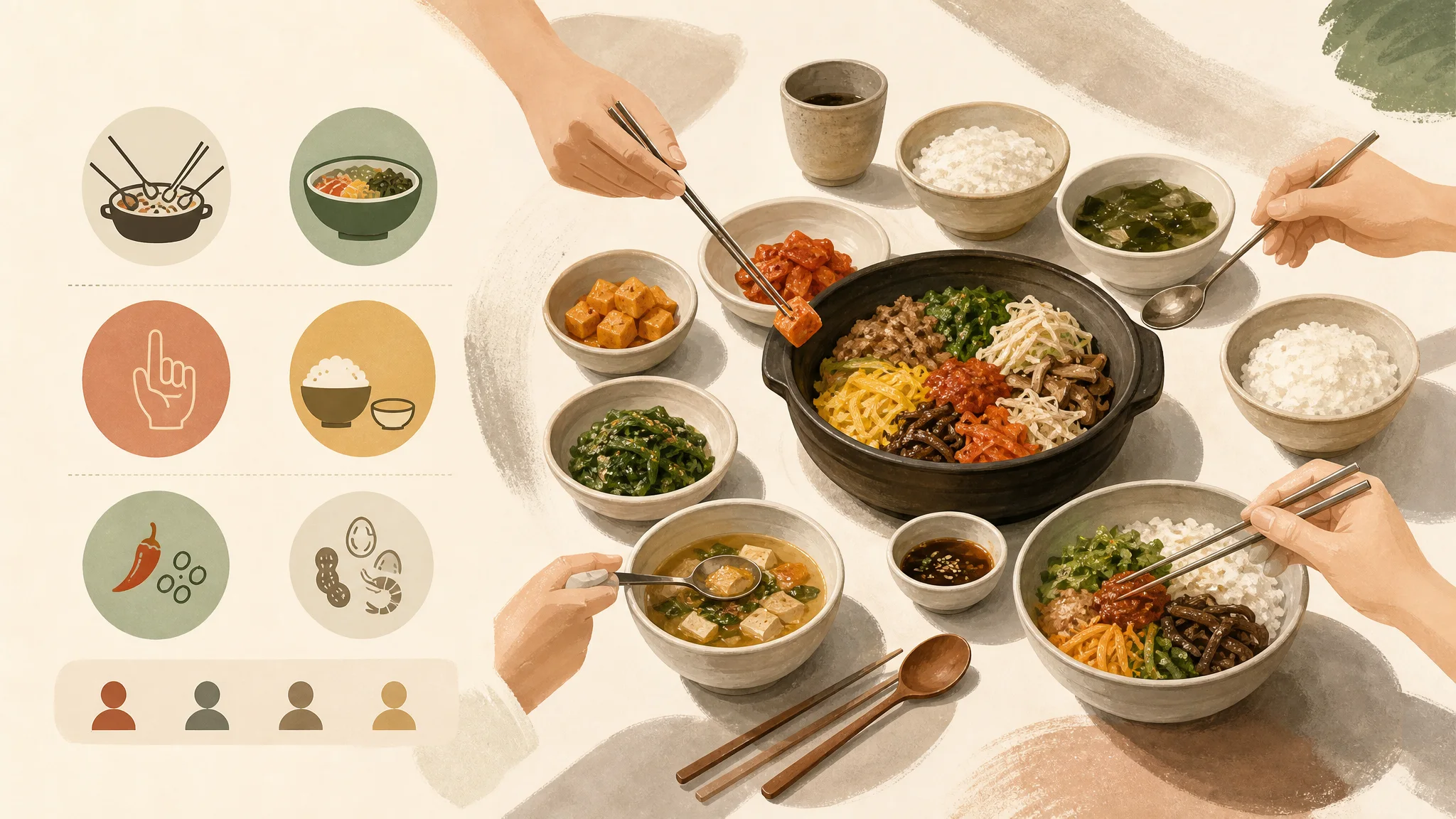
Key takeaway: Korean dining is a participatory experience in which people sharing one table mix and wrap shared side dishes and ingredients to form "their own meal." As a tourist, try bibimbap (mixing), ssam (wrapping with lettuce/perilla), and combining set meals or stews to create your preferred bites. Prices vary by time and place (based on 참가격: Seoul bibimbap about ₩11,700, etc.), and lunch specials or set-menu lunches usually offer good value.
Which dishes are 'participatory' — recommendations and ordering tips by situation
- Bibimbap (mixing): the easiest participatory dish to try alone. Diners complete the flavor by mixing ingredients themselves. Popular tourist spots may offer premium versions (seafood, hanwoo beef toppings), so check the price.
- Ssam (wrapping meat/veg in lettuce or perilla): central to Korean barbecue (e.g., samgyeopsal). The act of grilling and assembling ssam is part of the experience.
- Set meals / stews (baekban / jjigae such as kimchi-jjigae): multiple side dishes arrive on the table, so you can sample a range of flavors and make your own combinations.
- Point: the core of "participatory" dining is that diners combine ingredients themselves and complete the final taste (VisitKorea explanation).
Price & timing guide (based on verified public data)
| Menu type | Seoul (참가격 public average, recent) | Practical tip |
|---|---|---|
| Bibimbap | about ₩11,700 (참가격, varies by time/place) | Tourist spots often cost more. Search for lunch specials (11:00–15:00). |
| Kimchi-jjigae (set meal) | about ₩8,650 | Hearty and cost-effective — side dishes let you try multiple flavors. |
| Kalguksu | about ₩10,000 | Easy solo meal; popular in morning/lunch hours. |
| Gimbap (one roll) | about ₩3,800 | Good for on-the-go, markets, or a light meal. |
(These figures use the Korea Consumer Agency '참가격' Seoul averages; prices vary by survey time, business type, and whether the place is in a tourist area.)
Many restaurants run weekday lunch specials roughly 11:00–15:00, so the same dish can be cheaper at lunchtime (check local menus).
Ordering & phrases — minimal Korean to order comfortably
- Basic orders
- "비빔밥 하나 주세요." (Bibimbap hana juseyo.) — "One bibimbap, please."
- "김치찌개 백반 2인분 주세요." (Kimchi-jjigae baekban du-inbun juseyo.) — "Two servings of kimchi-jjigae set, please."
- Asking about lunch specials
- "오늘 점심특선 있나요?" (Oneul jeomsim-teukseon innayo?) — Ask if a lunch special or discounted set is available.
- Diet & allergy requests
- "채식주의자예요. 고기 빼 주실 수 있나요?" (Chaesikjuuija-yeyo. Gogi bbae jusil su innayo?) — "I'm vegetarian. Can you leave out the meat?"
- "새우/조개/멸치에 알레르기가 있어요. 이 반찬에 들어가나요?" (Saeu / jogae / myeolchi-e allergy isseoyo. I banchan-e deureogayo?) — "I am allergic to shrimp/shellfish/anchovy. Is this side dish made with it?"
- Side-dish refills
- "반찬 더 주세요." (Banchan deo juseyo.) — "More side dishes, please." Many places offer free or charged refills depending on the restaurant.
- Call-for-service
- "저기요!" or "여기요!" (Jeogiyo! / Yeogiyo!) — Used to get a server's attention (similar to "Excuse me").
Phrase tips: restaurants differ in how they can accommodate allergies or vegetarian requests. If there is no foreign-language menu, showing a short Korean sentence can help.
Ingredients & allergy precautions (practical)
- Side dishes often use seafood-based seasonings such as dried anchovies (myeolchi), salted shrimp (saeujeot), or fish sauce. Fermented ingredients like doenjang or jeotgal (fermented seafood) are common—if you have seafood allergies or are vegetarian, always ask.
- Gochujang and red pepper powder make dishes spicy. To avoid heat, request "안 맵게 해 주세요." (An maepge hae juseyo.) — "Please make it not spicy."
- Strict vegetarian or religious dietary needs vary by restaurant; ask in advance if possible.
Quick checklist — 60-second decision rules for what to pick
- Number of people and participation level: solo → bibimbap or stews; groups of 2+ → barbecue/ssam.
- Budget guideline: ₩10,000–15,000 per person is a reasonable meal (참가격 guidance); premium experiences (hanwoo or seafood) cost more.
- Dietary restrictions: if allergic to seafood or vegetarian, use an allergy/vegetarian phrase before ordering.
- Timing tip: aim for lunch (11:00–15:00) for likely lunch specials and lower prices.
(Quick note: prices, menu makeup, and opening hours vary by region and over time. Use public, official average prices as a planning guide.)
Who this guide fits, trade-offs, and changing factors
- Who: first-time visitors to Korean food, people curious about shared side-dish culture, and travelers who want practical ordering language while considering budget and dietary limits.
- Trade-offs: participatory menus (grill/ssam) are more experiential but depend on group size, budget, and concern about smoke/odor on clothing. Solo travelers and those with allergies may prefer bibimbap, set meals, or gukbap (soup-and-rice) for safety and cost.
- Changing factors: dining prices (참가격 averages change monthly and by region), tourist-area price premiums, and whether a restaurant serves a lunch special.
Sources and reliability: This guide interprets Korean dining culture (shared side dishes, bibimbap, ssam) based on Korea Tourism Organization (VisitKorea) materials and a Hankook Ilbo column republished by The Korea Times (both describe how people at the same table can end up eating very different meals). Price figures use the Korea Consumer Agency '참가격' public data for Seoul averages (e.g., bibimbap ≈ ₩11,700; kimchi-jjigae ≈ ₩8,650). Public exhibitions—such as the National Museum of Korea's 2026 exhibition on table culture—support the interpretation of the communal and cultural aspects of Korean dining.
If you want, tell me your travel purpose (e.g., Seoul meal under ₩12,000 with a vegetarian companion) and a date, and I can suggest specific restaurants, translate menus, help reserve, or analyze menu photos for you.