Quick answer — Bottom line: If it’s your first visit, start with bibimbap (regular or dolsot). It’s easy to adjust spiciness, add or remove meat, and by checking one sentence about allergies (jeotgal/soy/wheat) and sodium you’ll lower the chance of a bad experience.
Who this guide is for, and what trade-offs it covers - Audience: foreigners or beginners who don’t know Korean food well (including people with vegetarian, gluten, or seafood allergies). - Trade-offs: safety and simplicity (bibimbap, sundubu) vs. local/traditional experience (kimchi, hanjeongsik, Korean BBQ). Choosing safety usually means requesting no meat, no jeotgal, and milder spice — you may miss some traditional fermented/seafood flavors. - Situations that can change things: how restaurants label allergens, export recipes for processed sauces (export gochujang may differ in sugar, sodium, or gluten), and seasonal/market price changes (average bibimbap prices in Korea vary by time).
Six dishes good for beginners and why - Bibimbap (regular / dolsot): rice with seasoned vegetables and egg, meat optional. Easy to control spiciness and meat. - Bulgogi (rice bowl / bulgogi): sweet-savory soy-based grilled beef, usually not spicy and approachable for many foreigners. - Kimchi jjigae (kimchi stew): a classic way to taste Korean stew — check whether the kimchi contains fermented seafood (jeotgal) or whether the broth uses meat stock. - Sundubu jjigae: soft tofu stew, creamy and often spicy; check for seafood or pork in the stew. - Tteokbokki: street-food spicy rice cake snack — can be very spicy. - Korean BBQ (pork/beef): a memorable experience but consider per-person cost and the service style (table grill or staff-grill).
Prices and timing (range examples) - Korea (Seoul): Bibimbap at chains or typical Korean restaurants is commonly around 10,000–14,000 won. This average can change with market and produce prices. - United States (varies by city): Dolsot bibimbap and similar Korean entrees vary widely by restaurant tier and location — casual/neighborhoood places $12–$25; upscale restaurants or specialty items can be $35–$50+. AYCE (all-you-can-eat) Korean BBQ examples have been reported in the $30–$43 range.
(Why: price ranges are based on local restaurant and delivery listings and regional reporting.)
Ordering phrases (Korean original + simple pronunciation / when to use) - Basic ordering - 비빔밥 하나 주세요. (Bibimbap hana juseyo.) — easy to order; you can request modifications. - 돌솥비빔밥으로 주세요. (Dolsot bibimbap-euro juseyo.) — request for a hot stone pot with a crisp nurungji texture. - Spiciness, meat, and side-dish requests - 맵지 않게 해 주세요. (Maepji anke hae juseyo.) — ask to make it less spicy. - 고기 빼 주세요 / 고기 빼고 해 주세요. (Gogi ppae juseyo.) — remove meat to make it closer to vegetarian. - 김치에 젓갈(멸치액젓/새우젓) 들어가나요? (Kimchi-e jeotgal deureogana-yo?) — check whether kimchi or side dishes include fermented seafood (jeotgal). - Allergy / special requests - 저는 해산물(또는 새우, 멸치)에 알레르기가 있어요. 빼 주실 수 있나요? (Jeoneun haesanmul (ttoneun saeu, myeolchi)-e allergiga isseoyo. Bbae jusil su isseoyo?) - 글루텐/밀을 피해야 합니다. (Glu-ten/mil-eul pihaeya hamnida.) — request to check for wheat/gluten in gochujang, soy sauce, or noodles.
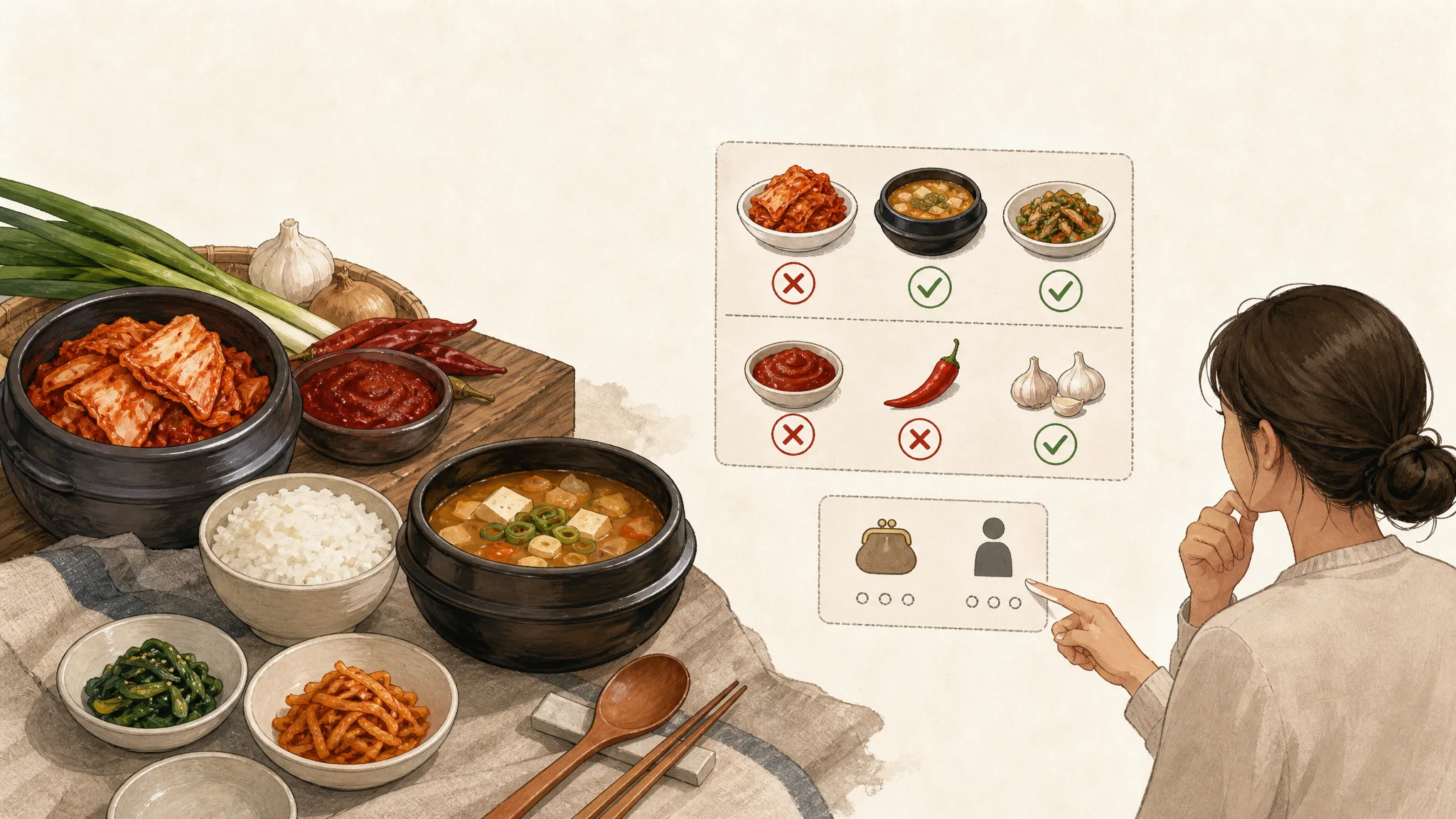
Allergy & dietary checklist (ask before ordering) - Kimchi: Traditional kimchi recipes often include anchovy fish sauce or salted shrimp (jeotgal), so check if you are vegetarian or allergic to seafood. - Gochujang: Commercial gochujang brands commonly list wheat (gluten) and soybean, so if you have wheat or soy allergies check ingredients or ask for alternatives. - Broths and stocks: Many stews and soups are based on anchovy, beef, or pork stock — ask “What stock do you use?” - Sodium: Gochujang, soy sauce, and jeotgal can be high in sodium. If you have high blood pressure or need a low-sodium diet, ask about salt level and side-dish refills.
Quick decision rules (fast checklist) 1) First-timer / low risk: Bibimbap (dolsot) — choose spiciness and meat options → high chance of success. 2) Vegetarian or seafood allergy: Ask whether kimchi or stews use jeotgal → remove meat and add egg for protein. 3) On a budget: Choose convenience / chain Korean spots (bibimbap, kimchi jjigae) → typically 10,000–15,000 won in Korea. 4) Special experience (Korean BBQ): Decide group size and budget first; check whether it’s AYCE and what cuts/grill style are offered.
Short English patterns to use when ordering - "Is the kimchi made with fish sauce?" — confirm jeotgal in kimchi. - "Could you make it less spicy/no meat?" — spiciness and meat requests. - "Are there wheat/soy ingredients in the sauce?" — check gochujang/soy sauce ingredients.
What else to watch for (uncertainties / checkpoints) - Processed gochujang and doenjang products for export may include added sugar, starch syrups, alcohol (fermentation agents), and wheat — check labels. - Prices at overseas (U.S. etc.) restaurants vary widely by downtown location, upscale venues, and delivery-platform listings — check the restaurant’s official menu when budgeting.
Quick one-sentence summary Start with bibimbap, and before eating check spiciness, meat inclusion, and whether kimchi contains jeotgal — that will handle most allergy, preference, and budget issues.
Table (at-a-glance comparison of main dishes)
| Dish | Korea (Seoul) price range (example) | U.S. (city) price range (example) | Spiciness / difficulty | Vegetarian suitability (check first) |
|---|---|---|---|---|
| Bibimbap / Dolsot Bibimbap | 10,000–14,000 won (chain example) | $12–$50 (casual→upscale) | adjustable | Can be mostly vegetarian if meat removed (watch for jeotgal in kimchi) |
| Bulgogi (rice bowl) | 10,000–15,000 won | $15–$40 | usually not spicy | contains meat (not vegetarian) |
| Kimchi jjigae | 8,000–13,000 won | $12–$25 | mild→spicy | check kimchi for jeotgal and broth for meat stock |
| Tteokbokki | 5,000–12,000 won (snack shops) | $8–$18 | can be spicy | often not vegetarian (check broth/essence) |
| Korean BBQ (table) | per person ~12,000 won↑ (varies by cut/restaurant) | $20–$80+ (varies by cut/restaurant) | cook at table or staff-grilled | meat-focused (not vegetarian) |
Finally — quick checkbox to use on the spot
- [ ] 김치에 젓갈(멸치/새우) 들어가나요?
- [ ] 고추장·간장에 밀(글루텐)·콩(대두)이 들어가나요?
- [ ] 덜 맵게/고기 빼 주세요(원하는 대체 옵션 제시).
Variability note: The prices and ingredient details above can change depending on restaurant, brand, export product labeling, and market prices. For exact menu prices and ingredients, check the restaurant’s official menu page or the product label.
Author’s note (evidence & basis): This guide summarizes ordering rules and phrases based on cross-checking Korea Tourism Organization and official Korean government recipes, academic/research sources (World Institute of Kimchi), manufacturer and retailer product labeling, restaurant/delivery menus, and regional reporting examples.